
Evidence-linked prior authorization with automation where it helps and clinical control where it matters.
IXB runs prior authorization from electronic intake through criteria review, clinical determination, provider communication, appeals, and audit history. The request, the criteria applied, the evidence submitted against each one, the reviewer, and the rationale stay attached to the same case — and to the benefit rules that made the authorization necessary.
The workflow that changes what the engine decides.
A prior authorization is not a document — it is a change to what happens next for the member. IXB Prior Authorization can connect the request, criteria, submitted evidence, determination, and effectuation evidence to the applicable benefit and claim context through governed integrations.
- The coverage barrier that triggered the request can be linked to the case.
- The determination and its version history stay attached to the record.
- Turnaround, decisions, and overturns report from the case record itself.
Prior authorization needs more than a portal.
Health plans need timely, consistent, well-documented decisions across lines of business, benefit types, delegated arrangements, provider channels, and changing regulatory expectations. When requests, criteria, evidence, follow-up, reviewer notes, and decision records live in separate systems, teams lose time chasing information — and leaders lose visibility into status, aging, quality, and rationale.
Volume and variation
Requests arrive across drugs, services, procedures, imaging, DME, and other categories — each with different rules, timelines, criteria, and documentation needs.
Manual review pressure
Clinical and operational teams need to focus their time where judgment is required — not on hunting for forms, missing evidence, status updates, or duplicate data entry.
Provider friction
Incomplete requests, unclear documentation requirements, and inconsistent status communication create unnecessary back-and-forth with provider offices.
Oversight and reporting
Plan leaders need defensible reporting on turnaround time, approvals, denials, requests for more information, appeals, aging work, and reviewer activity.
A payer operating system for prior authorization work.
IXB gives health plans and PBMs a structured system for the recurring work behind prior authorization — request intake, benefit and criteria checks, decision assessment, evidence management, clinical review, provider follow-up, determination documentation, reporting, and audit support.
Electronic prior authorization intake
Support electronic prior authorization workflows and organize incoming requests into standard work queues for pharmacy and medical PA operations.
Criteria and evidence organization
Keep request details, policy criteria, supporting documentation, reviewer notes, and decision rationale tied to the same case record.
Decision Assessment
Surface approval, denial, and clinical-review guidance based on request data, criteria, documentation, and plan rules — while authorized users stay in control of final determinations.
Clinical review queues
Route cases by priority, benefit type, line of business, missing information, aging status, reviewer assignment, or other operational rules.
Provider communication tracking
Track requests for missing information, clarification messages, documentation status, and follow-up activity in workflow — not across email, fax, and spreadsheets.
Determination documentation
Capture decision outcome, rationale, criteria references, timestamps, reviewer activity, and communication history for audit and oversight.
Plus operational dashboards for leaders — volume, aging, turnaround, outcomes, reviewer load — and healthcare-grade security controls, all from the same source of record.
From intake to determination, every step stays connected.
Because the workflow runs in one connected system, teams don’t stitch together requests, documentation, decisions, and reporting after the fact. The record used to manage the case is the record used for oversight, quality review, compliance reporting, and analytics.
Automation where it helps. Clinical control where it matters.
Decision Assessment helps payer teams evaluate requests against available evidence, documentation, and plan criteria. Routine cases are organized for faster review, incomplete cases are flagged for follow-up, and cases requiring clinical judgment route to the right reviewer. The goal is not a black-box decision process — it’s a consistent, reviewable workflow where authorized users see the information used, understand the recommended next action, and document the final determination.
Approve faster when evidence is complete
Identify requests that appear to satisfy configured criteria and are ready for approval review.
Route uncertainty to clinical teams
Send incomplete, complex, conflicting, or policy-sensitive requests to the appropriate reviewer queue.
Preserve rationale and oversight
Track criteria, evidence, guidance, user edits, overrides, timestamps, notes, and final determinations in the case history.
Built for the shift toward electronic prior authorization.
Prior authorization is moving toward more structured electronic exchange, tighter operational timelines, and more public performance reporting. IXB is designed to help payer organizations modernize without losing control of criteria, review discipline, or audit history — separating pharmacy ePA workflows from medical PA API requirements while keeping teams focused on the same core problem: timely, consistent, well-documented decisions.
- Pharmacy ePA workflow support for medication PA operations
- Medical PA workflow support aligned to emerging payer API and FHIR expectations
- Decision timelines and aging dashboards for standard and expedited requests
- Reporting views for turnaround, approvals, denials, and information requests
- Case history tying determinations to data, criteria, evidence, and communication
Know where every authorization stands.
Eight views from the working system — from a reviewer’s prioritized desk to the reports a plan shows its regulators, and what providers see on their side.

A reviewer's day, prioritized. Assigned cases with live regulatory clocks, due-soon and missed-timeframe alerts, and queue shortcuts — so expedited work surfaces before deadlines hit, not after.
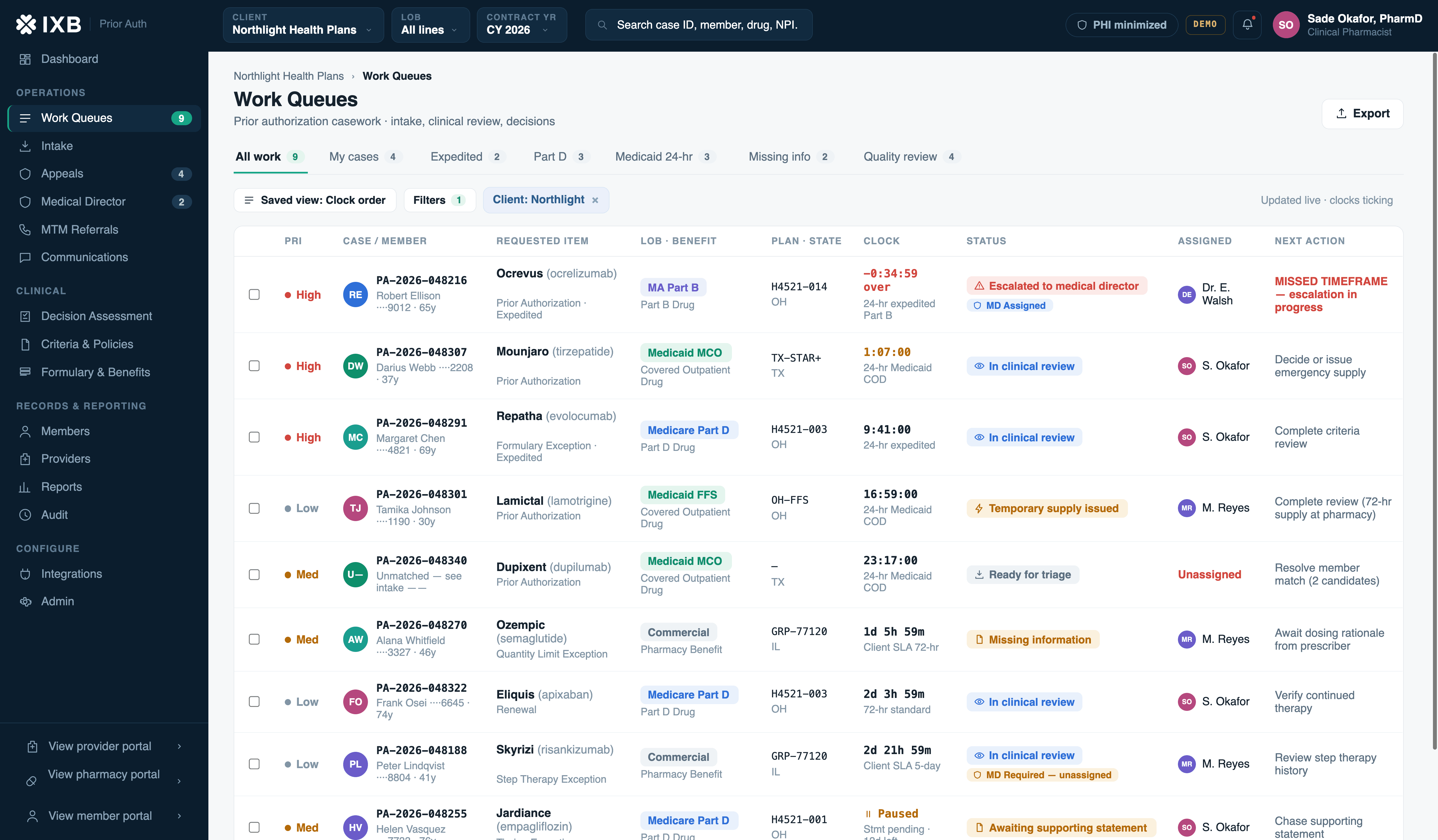
Clock-ordered casework. Every request with its line of business, plan, regulatory clock, status, owner, and next action — filterable into expedited, Part D, Medicaid 24-hour, missing-information, and quality-review lanes.

Evidence-linked criteria review. Criteria verify against claims, Rx history, and lab feeds where evidence exists — each with its source shown. Anything unknown stays flagged for the reviewer, and clinical accountability remains with the reviewer. Marking a criterion writes a time-stamped, reviewable audit event.
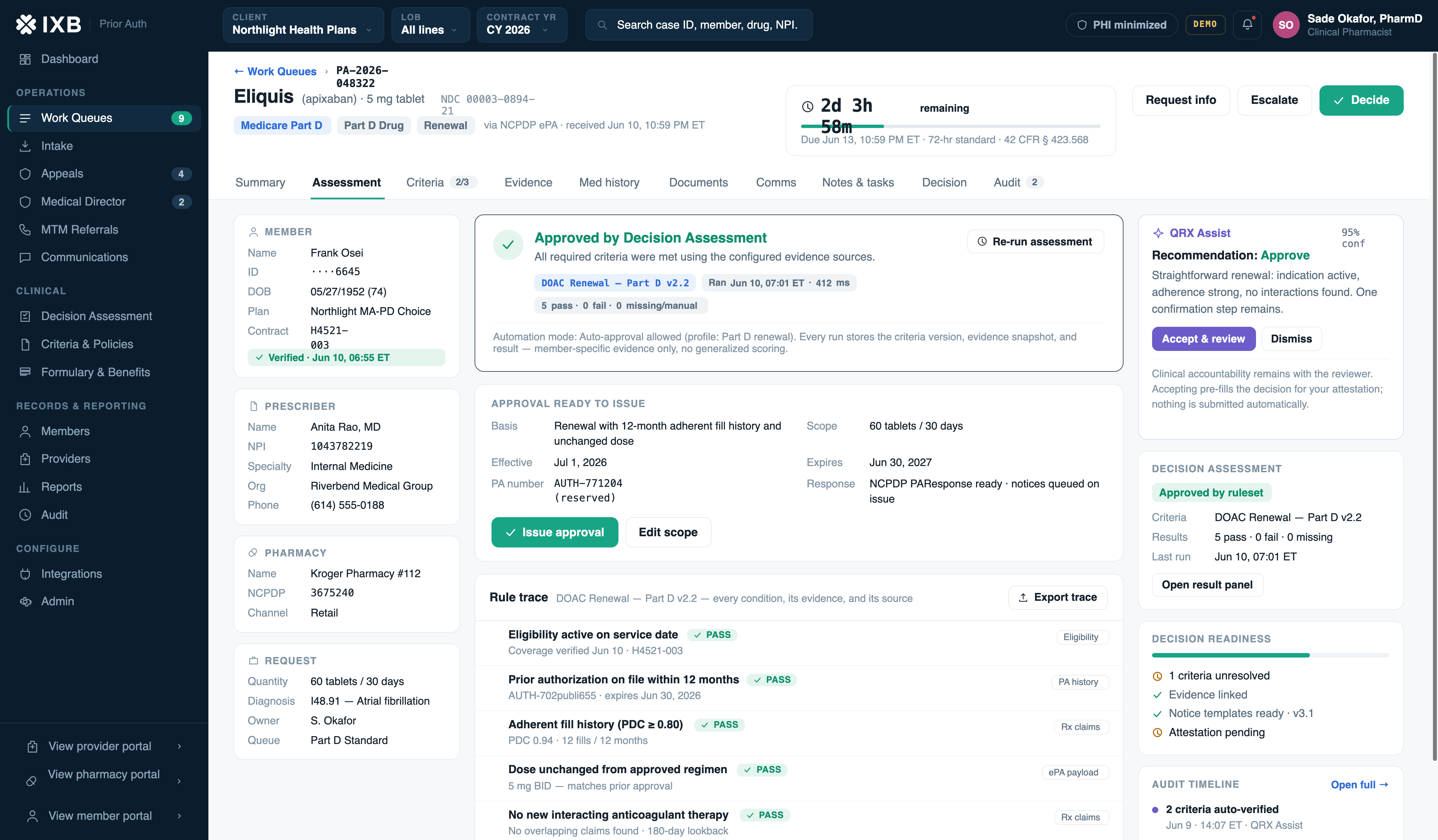
A rule trace behind every assessment. When a routine renewal meets all configured criteria, the approval is staged with its basis, scope, and effective dates — and every run stores the criteria version, evidence snapshot, and full rule trace. Nothing is submitted without authorized review.
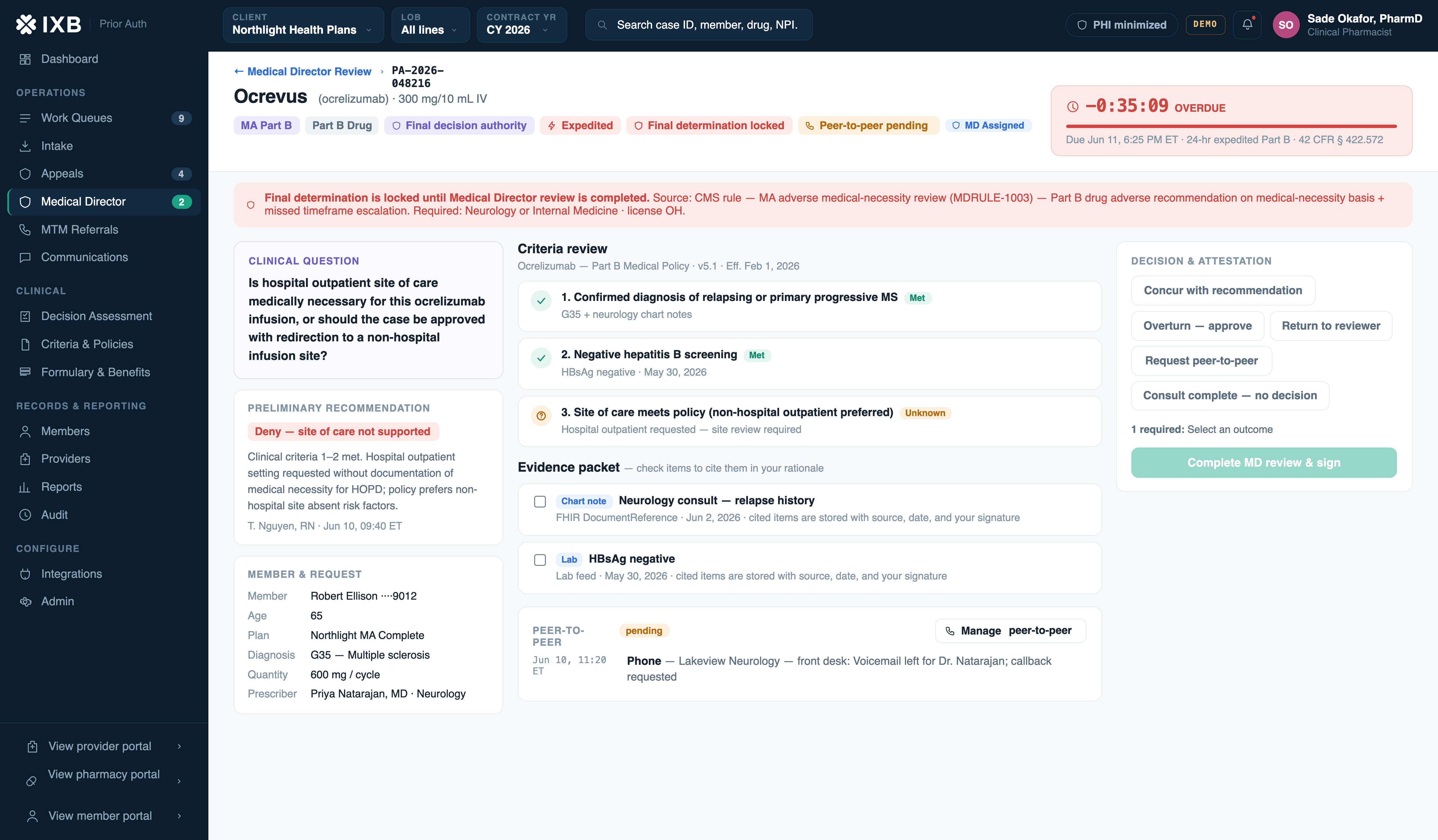
Escalation with decision discipline. Adverse and escalated cases lock until medical director review is complete — with the clinical question framed, the evidence packet citable, peer-to-peer activity tracked, and the final determination signed and attested.
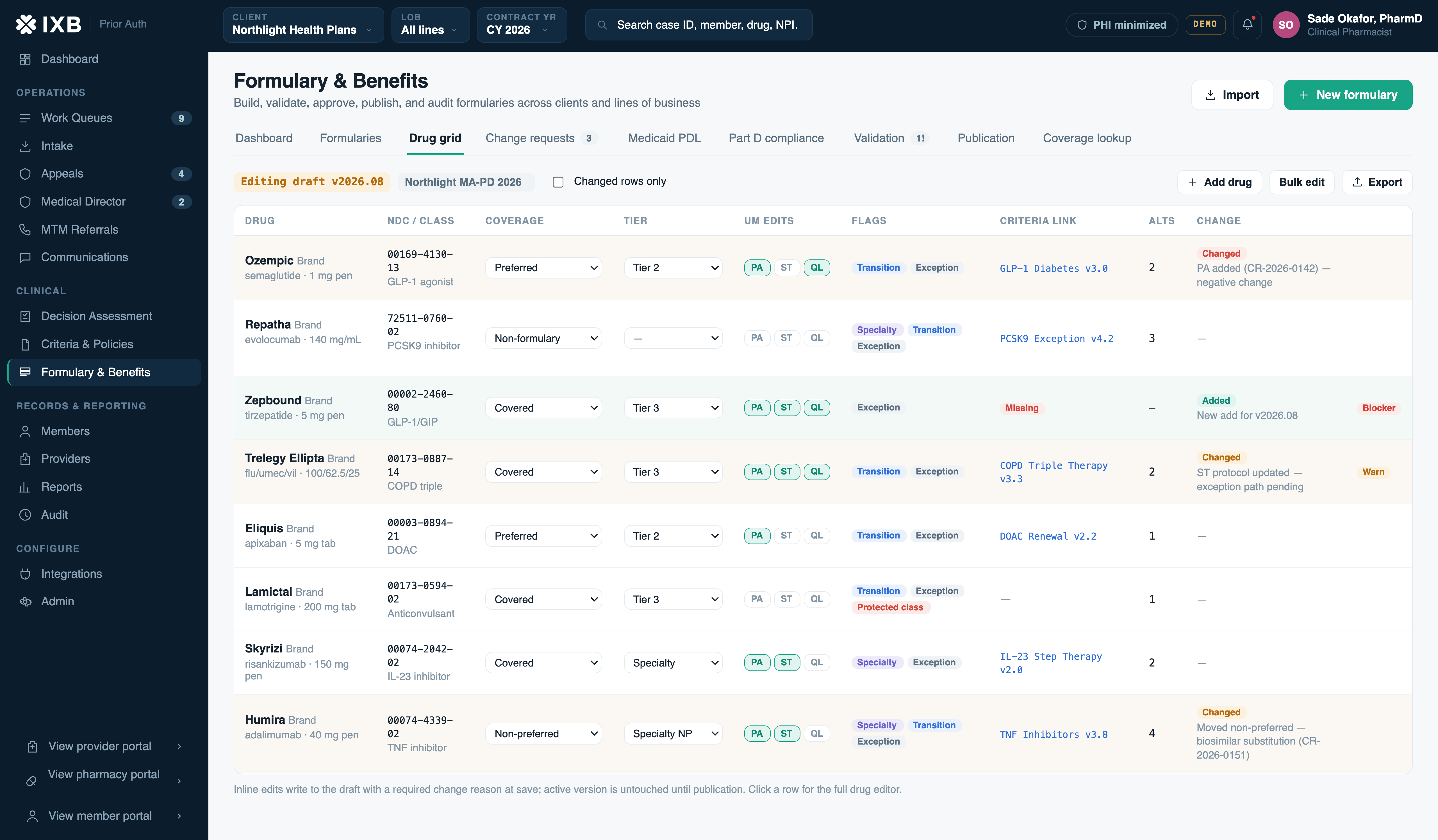
Formulary, versioned and validated. Coverage, tiers, UM edits, and criteria links managed in drafts with required change reasons, validation blockers, and compliance checks — the active version stays untouched until publication.
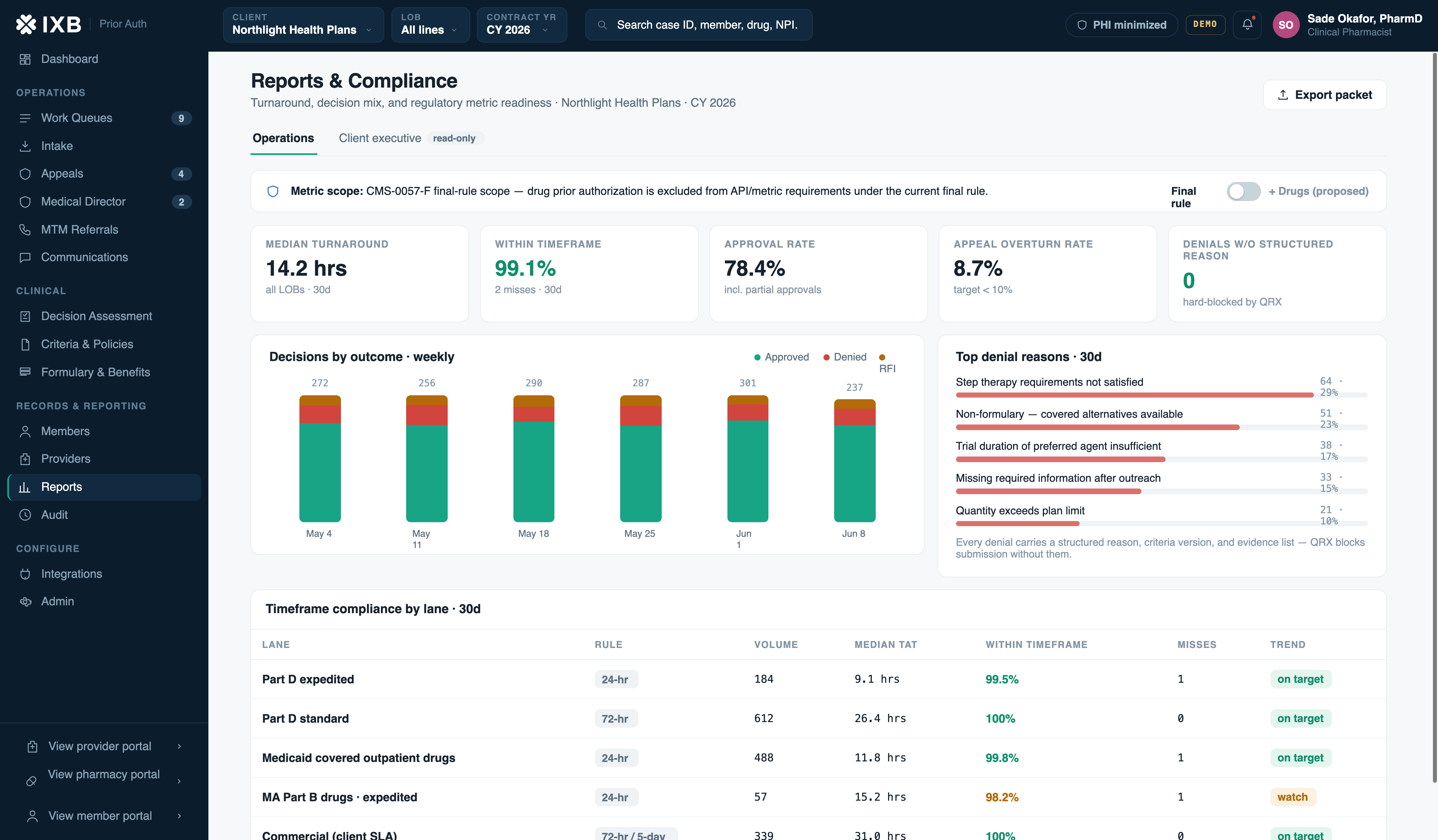
Turnaround you can stand behind. Median turnaround, within-timeframe rates by regulatory lane, decision mix, and structured denial reasons — every denial carries its reason, criteria version, and evidence list. Designed to support the shift toward public performance reporting.
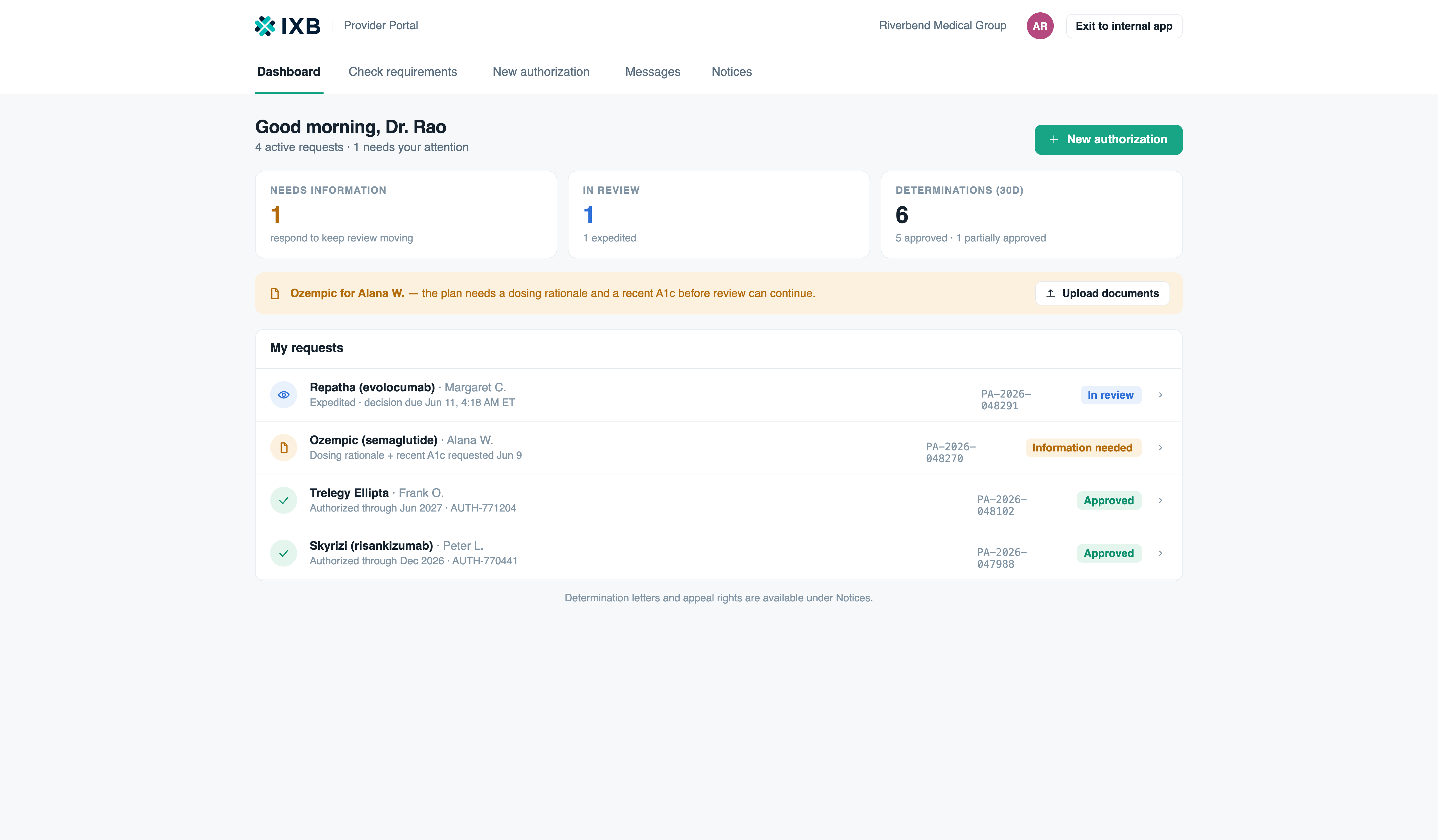
Less back-and-forth with provider offices. Providers see live request status, respond to information requests with document upload, and pull determination letters — reducing avoidable calls and faxes on both sides.
Demo environment. Clients, members, prescribers, and figures shown are fictional and illustrative.
Designed for payer teams that need speed, control, and proof.
Reduce manual touches
Standardize intake, queues, evidence checks, follow-up, and determination documentation so teams spend less time chasing information.
Improve turnaround visibility
Track standard and expedited requests by due date, priority, aging, and queue owner — so leaders see risk before timelines are missed.
Support provider relationships
Make missing information, status, and follow-up clearer and more consistent, reducing avoidable back-and-forth with provider offices.
Keep criteria and rationale connected
Tie decisions to the request, criteria, evidence, reviewer activity, timestamps, and communication history.
Strengthen oversight
Give compliance, clinical leadership, and operations a reviewable record of how requests moved through the workflow.
Prepare for electronic workflows
Support payer modernization initiatives across ePA, APIs, FHIR-aligned workflows, reporting, and operational analytics.
Built for protected health information and regulated payer workflows.
IXB is built to process sensitive healthcare data for regulated organizations. Prior authorization workflows are protected with security practices appropriate for PHI and payer operations.
Built on IXB’s payer workflow foundation.
IXB already supports regulated healthcare workflows for health plans, PBMs, Medicaid-sponsored programs, Medicare plans, and Commercial programs. Prior Auth extends the same operating model — structured workflow, traceability, reporting, and secure data handling — to utilization management and electronic prior authorization operations.
The platform organizes the case. Reviewers make determinations.
The request, applicable criteria, submitted evidence, missing information, communication, regulatory clock, and audit history remain connected in one case. Authorized reviewers apply clinical judgment and issue the determination of record.
The platform supports
Assembly and comparison, shown with its sources.- Present submitted evidence against applicable criteria
- Identify missing required information
- Track deadlines, communications, and escalation
- Preserve criteria versions and audit history
The authorized reviewer alone
Clinical judgment and the determination of record.- Issues an approval, denial, or partial determination
- Applies clinical judgment to an ambiguous case
- Escalates to a medical director
- Attests to a determination
- Decides an appeal
- Structured evidence
- Authorized review
- Versioned criteria
- Complete audit history
On adverse determinations. A denial is a clinical decision made by an authorized reviewer. The audit history shows who made it, on what evidence, and against which criteria version.
Connect authorization with the next step in specialty care
TGRX is designed to connect specialty authorization activity with pharmacy handoffs, access barriers and ongoing member follow-up.
Let's talk about your prior authorization workload.
Tell us where cases stall today and what your turnaround requirements look like.